Select the right grease—Understanding Grease Types and Applications
The right grease doesn’t always mean choosing the high-quality grease. Many companies invest their time and money in premium greases, assuming that the premium means better performance. But don’t confuse the quality of the lubricant with the quality of the specification.
For example, the high-quality turbine oil cannot be used as an engine oil even though it is considered an excellent lubricant. This same thing happens while selecting the right grease as well.
You need to understand the grease types and applications to ensure efficiency, reliability, and long equipment life. Check our EP220 vs EP460 grease.
Selecting the Right Grease for the Application
When it comes to lubricant selection, most users understand its importance. OEM specifications make this process easy by including different information like:
- Viscosity at operating temperature
- Additive requirements
- Base oil type
- Environmental considerations.
On the other hand, grease specifications are often less and OEM recommendation also doesn’t specify the detailed information.
This lack of detail makes a proper grease selection guide essential, especially in industrial environments.
Why Grease Selection Is More Complex Than Oil Selection
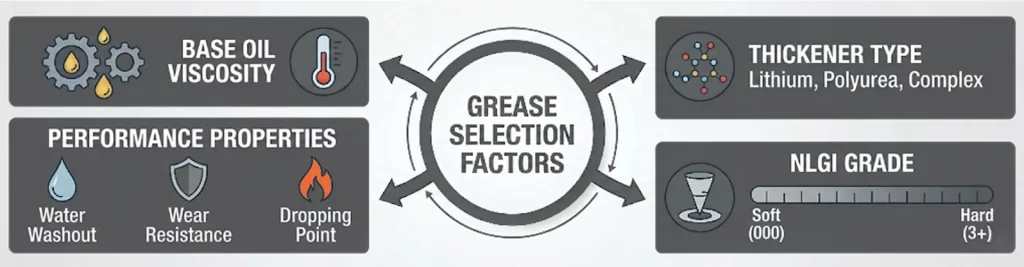
The selection process of grease includes all the steps that are included in the selection of the oil and a few more. Instead of circulating, grease stays in place and because of that its structure and stability are very important. In addition to base oil properties, grease selection should be done by keeping in mind the following:
- Thickener type and concentration
- NLGI grade (grease consistency)
- Dropping point and operating temperature range
- Mechanical and oxidation stability
- Wear resistance and load-carrying capability
Base Oil Viscosity – The Most Critical Property
The foremost and the most crucial property of any oil or grease is viscosity.
The most common mistake users make while selecting grease is getting confused between grease consistency and base oil viscosity. These are two different properties. Base oil viscosity determines the thickness of the lubricating film. Consistency determines how hard or soft the grease is.
Most grease-lubricated components, especially rolling element bearings, rely on the base oil to provide actual lubrication. The base oil viscosity must be selected based on:
- Speed
- Load
- Operating temperature
For example, while an EP 220 oil might be suitable for slow, heavily loaded gears, that same viscosity would be far too thick for a high-speed electric motor bearing—even if it’s delivered in grease form. Check our latest update about grease for electric motor applications.
Additives and Base Oil Type
The next step that comes after selecting the correct base oil viscosity is choosing the right grease additives and base oil type. A high-speed bearing that has a light load will not require EP additives. While on the other side, a slow-speed, heavy-load piece of equipment may require EP.
Additives improve grease performance by:
- Improving anti-wear properties
- Handling heavy loads (EP additives)
- Improving corrosion resistance
- Reducing friction in boundary lubrication
API Group I or II mineral oils are used for most of the grease formulations. Synthetic base oil are used when
- Operating temperatures are very high or very low
- Ambient temperatures vary widely
- Extended relubrication intervals are required
Grease Consistency and Thickener Type
Grease consistency is determined by:
- Thickener type
- Thickener concentration
- Base oil viscosity
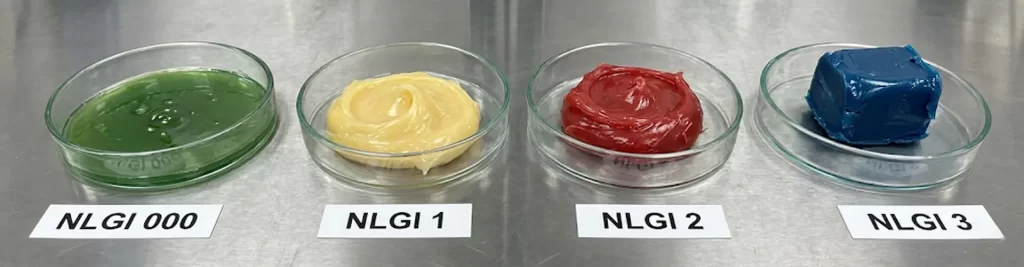
The National Lubricating Grease Institute (NLGI) categorizes greases based on consistency.
- NLGI 000–0: Semi-fluid greases
- NLGI 1: Softer greases suitable for high speeds or cold conditions
- NLGI 2: Most commonly used grade for general applications
- NLGI 3 and above: Harder greases for high temperatures or vertical applications
Higher bearing speeds often require higher grease consistency. The most suitable NLGI grade can be determined by considering the speed and temperature together. You can explore our high temperature greases for industrial equipment.
Common Grease Thickener Types
- Simple lithium grease – economical, general-purpose
- Lithium complex grease – better high-temperature performance
- Polyurea grease – excellent oxidation stability and long service life
Thickener selection should also consider compatibility, especially when changing grease types. Check our latest blog about grease for marine and offshore equipment.
Grease Performance Properties
The last step after choosing the viscosity, additives, and consistency is to check the grease performance properties. This includes:
- Dropping point
- Mechanical stability
- Water washout resistance
- Oil bleed characteristics
- Pumpability
The significance of each property depends on the application. For example, high-temperature applications require a high dropping point. Low speed and heavy load applications require EP performance.
Not all grease can have all the properties. One grease can perform well in one area and may not perform well in another. So, the solution is to find the balance and select the best overall fit.
Understanding Grease Consistency and Penetration
Grease consistency is measured using penetration tests (ASTM D217).
Penetration measures how far a standardized cone sinks into the grease under controlled conditions. Based on this, greases are classified into NLGI grades.
5 different categories of penetration are:
Undisturbed – Grease that is in its original container.
Unworked – A sample that has received only minimal disturbance in being transferred from the sample can to the test cup.
Worked – A grease that has been subjected to 60 double strokes in a standard grease worker. NLGI classification is based on worked penetration.
Prolonged Worked – Grease that has been worked the specified number of strokes (more than 60), brought back to 77 degrees F and then subjected to an additional 60 double strokes in the grease worker.
Block—This is the penetration of a block grease, which is hard enough to hold its shape without a container.
Understanding penetration helps predict how grease will behave after handling, pumping, and extended service.
How Rexol Supports Grease Selection
Rexol selects grease based on the applications.
- Wide range of grease types for different applications
- Technical support to match grease properties to operating conditions
- Consistent formulations and quality control
- Flexible private label options for distributors and OEMs
Rexol supports selecting the right grease not just by relying on the datasheets but based on real-world performance. Whether the need is for Lithium EP grease for basic use or polyurea grease for critical applications, Rexol supports each step.
Rexol supports different industries:
- Industrial
- Agriculture
- Automotive
- Locomotive
- Marine
- Textile
- Metal Works
Final Thoughts
Selecting the right grease doesn’t always mean using the premium ones. Even the premium grease fails if you fail to understand how operating conditions affect the performance and working of the grease. Understanding how base oil viscosity, thickener type, additives, and consistency work together is very crucial.
Rexol helps you select the right grease to make your equipment last longer, and lubrication becomes a reliability tool—not a recurring problem.
Private labeling allows the distributors and industrial suppliers to have full control over the grease specification, performance level, packaging, and market positioning.
Private labeling gives you the freedom to build products around real application needs, instead of adjusting your market to a supplier’s catalog.
Partner with us for Private label grease manufacturing today.