What Is NLGI Grade in Grease? Complete Guide
When you look at a grease product name or technical data sheet, you may often see terms like NLGI 2, NLGI 1, or NLGI 00. For someone new to grease selection, these numbers can feel confusing.
But the idea is actually simple.
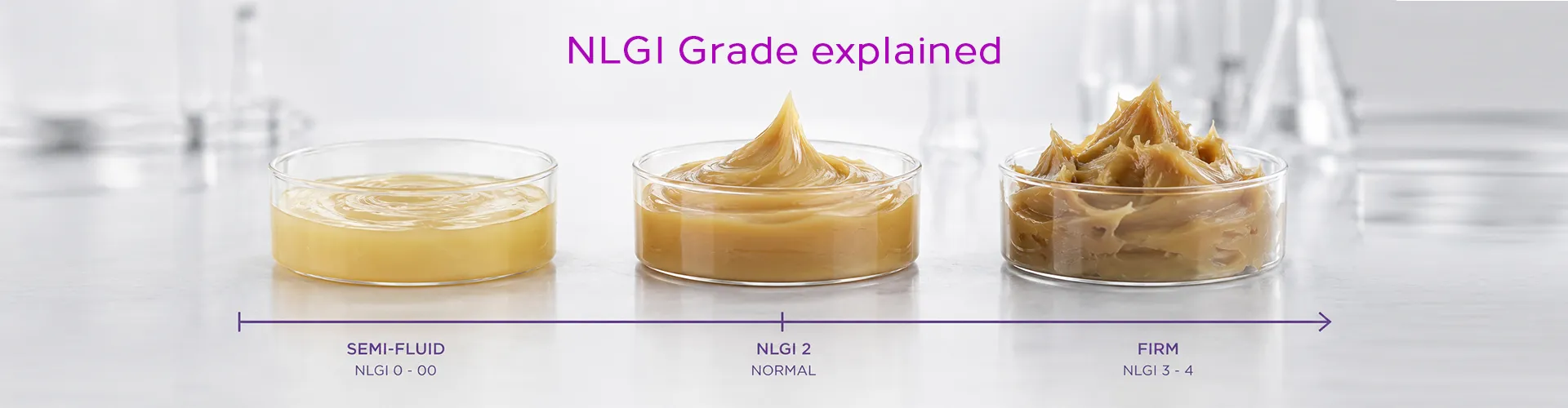
NLGI grease grade is a standard classification that shows the consistency of grease. A lower NLGI number means the grease is softer or more fluid, while a higher NLGI number means the grease is firmer or harder. It gives you a clear picture of the consistency of the grease and how it may behave in different applications.
In this guide, Rexol will explain to you what NLGI grade means, what NLGI 2 grease meaning is, how to read a grease consistency chart, and why grease classification matters when choosing the right product.
What Is NLGI Grease Grade?
NLGI grease grade is a classification system used to describe the thickness or consistency of lubricating grease.
In simple terms:
The NLGI grade specifies the thickness of the grease. By NLGI grade we can determine how firm or soft the grease is. It can be either very soft, hard, semi-fluid, normal, firm, or very hard.
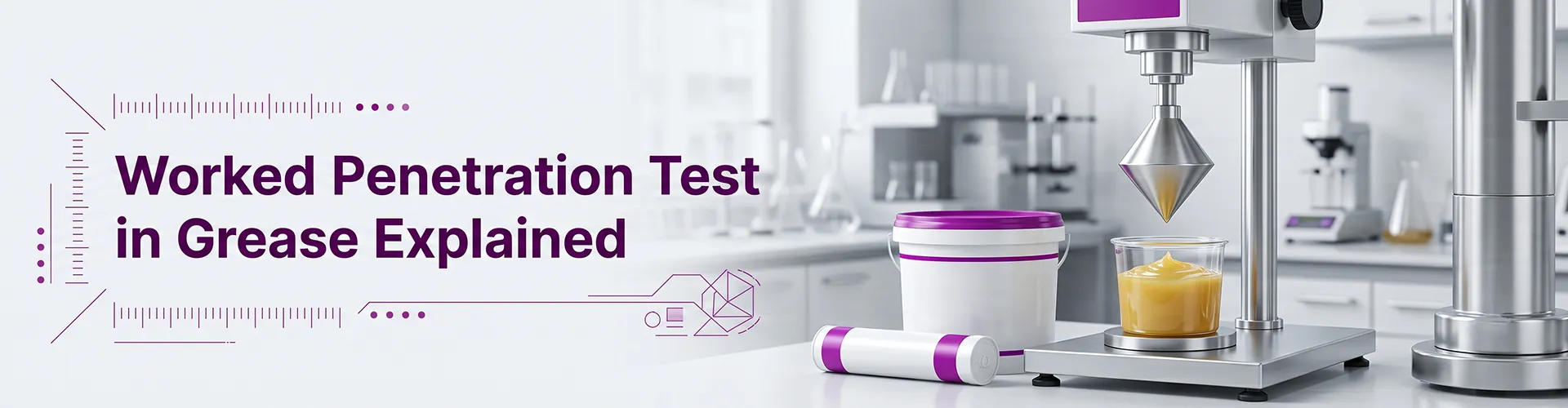
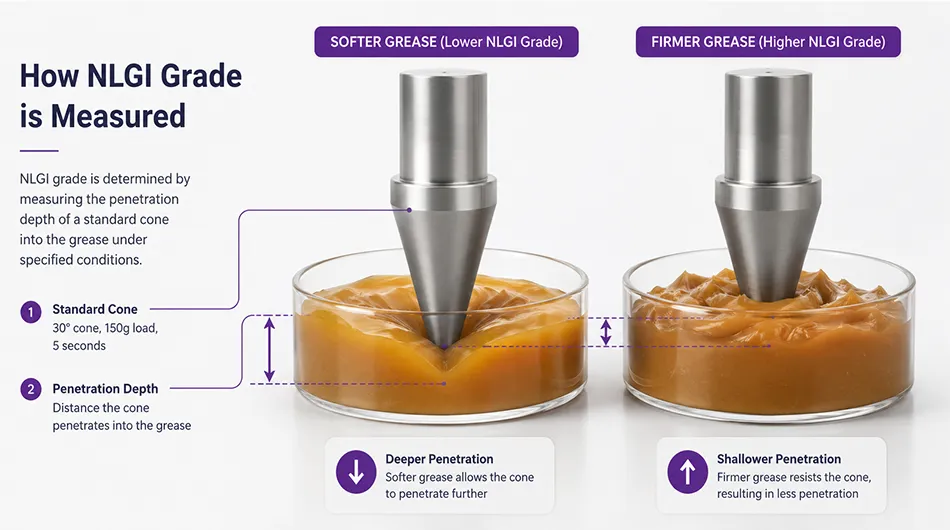
The grade is based on how much a standard cone sinks into the grease during a test. Softer grease allows the cone to sink deeper. Harder grease allows less penetration.
So, a softer grease tells you that the NLGI number is lower, while a thicker or harder grease tells you that the NLGI number is higher.
What Does NLGI Stand For?
NLGI stands for National Lubricating Grease Institute. This organization created a standard classification system that helps buyers, manufacturers, and maintenance teams to describe the grease consistency.
This makes it easier to compare products and choose grease for the right application.
Why Is NLGI Grade Important?
NLGI grades are very important because grease is mainly used to stay in place, move properly, and reach the lubrication point.
If the grease is too soft, it may leak out. If it is too hard, it may not flow or move properly inside the application.
Choosing the wrong consistency can lead to:
- Poor lubrication
- Grease leakage
- Difficulty in pumping
- Bearing overheating
- Increased wear
- Higher maintenance issues
- Product wastage
That is why NLGI grade should always be checked before selecting grease.
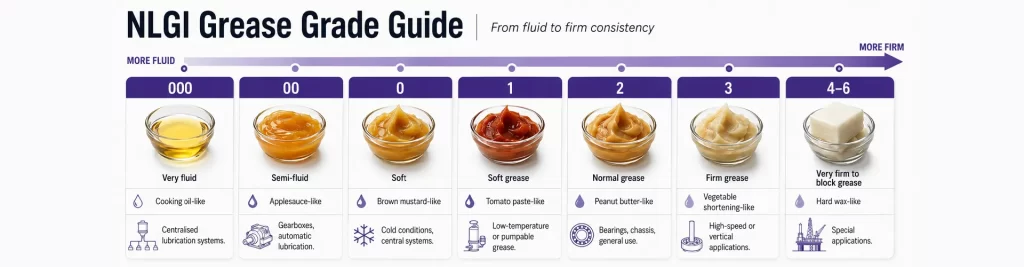
Grease Consistency Chart
The table below gives a simple view of common NLGI grades.
| NLGI Grade | Consistency | Simple Comparison | Common Use |
| 000 | Very fluid | Cooking oil-like | Centralised lubrication systems |
| 00 | Semi-fluid | Applesauce-like | Gearboxes, automatic lubrication |
| 0 | Soft | Brown mustard-like | Cold conditions, central systems |
| 1 | Soft grease | Tomato paste-like | Low-temperature or pumpable grease |
| 2 | Normal grease | Peanut butter-like | Bearings, chassis, general use |
| 3 | Firm grease | Vegetable shortening-like | High-speed or vertical applications |
| 4–6 | Very firm to block grease | Hard wax-like | Special applications |
This grease consistency chart is only a guide. Actual product performance also depends on the thickener, base oil, additives, and operating conditions.
What Is NLGI 2 Grease Meaning?
NLGI 2 grease is the most commonly used grease consistency for many general applications.
NLGI 2 grease means the grease has a medium consistency. It is firm enough to stay in place in many applications, but soft enough to move properly during normal lubrication. This is why NLGI 2 is commonly used in wheel bearings, chassis lubrication, industrial bearings, construction equipment and general maintenance
NLGI 2 grease is commonly used in:
- Wheel bearings
- Chassis lubrication
- Automotive workshops
- Industrial bearings
- Agricultural machinery
- General maintenance
- Construction equipment
For example, many Lithium EP grease, Lithium Complex grease, Moly grease and Calcium Sulfonate grease products are available in NLGI 2 grade because it works well in many common applications.
Does NLGI Grade Show Grease Quality?
No. This is an important point.
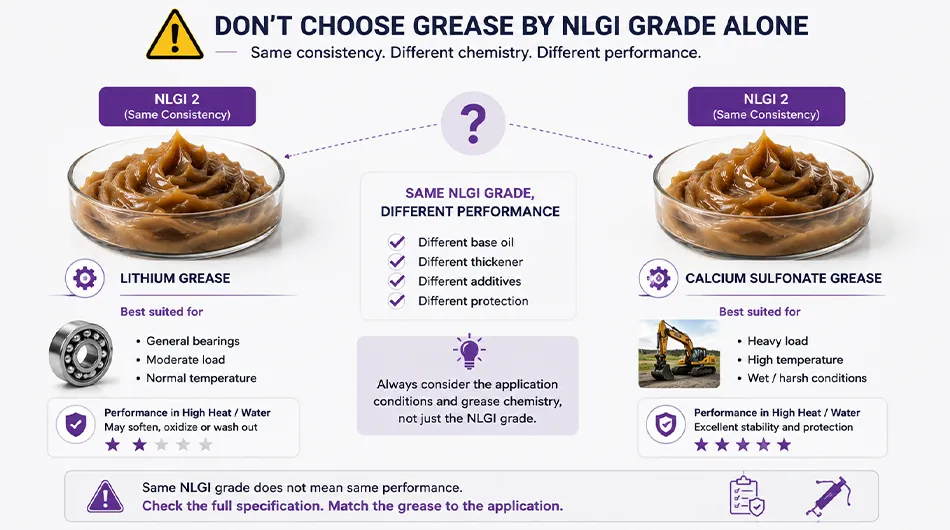
NLGI grade only tells you the consistency of the grease. It does not tell you whether the grease is high quality, low quality, water resistant, high temperature, EP type or suitable for your equipment.
Two greases can both be NLGI 2, but they may perform very differently.
For example:
| Grease Feature | Does NLGI Grade Tell This? |
| Consistency | Yes |
| Water resistance | No |
| Load-carrying performance | No |
| Temperature limit | No |
| Thickener type | No |
| Base oil viscosity | No |
| Additive performance | No |
| Application suitability | Not fully |
So, never choose grease only by NLGI grade. It is one important part of the selection process, but not the full answer.
How Is NLGI Grade Different from Grease Type?
Grease type and NLGI grade are different things.
NLGI grade tells you the consistency.
The grease type tells you what kind of grease it is, based on the thickener or performance.
For example:
| Term | What It Means |
| NLGI 2 | Medium consistency grease |
| Lithium grease | Grease made with lithium thickener |
| Moly grease | Grease containing molybdenum disulfide |
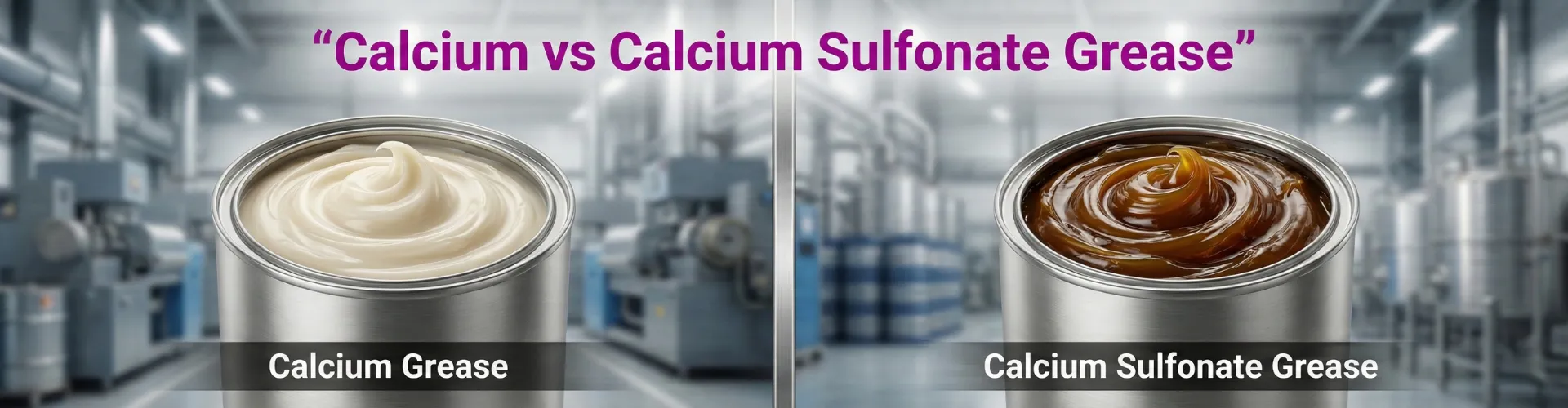
| Calcium sulfonate grease | Grease with strong water resistance and corrosion protection |
| Polyurea grease | Grease often used for long-life bearing applications |
This means you can have a lithium grease in NLGI 2, moly grease in NLGI 2, or calcium sulfonate grease in NLGI 2. The grade and grease type work together.
How Do You Choose the Right NLGI Grade?
The right NLGI grade mainly depends on the equipment and its working conditions.
Before choosing, check:
- Equipment manufacturer recommendation
- Bearing type
- Operating temperature
- Load condition
- Speed
- Pumpability requirement
- Centralized lubrication system needs
- Leakage risk
- Application method
- Product technical data sheet
For general maintenance, NLGI 2 is often used. For centralized lubrication systems, softer grades such as NLGI 00, 0, or 1 may be preferred. For special applications where grease must stay firmly in place, a higher grade may be needed.
Common Mistakes When Reading NLGI Grade
Many buyers misunderstand NLGI grades. Here are some common mistakes:
- Thinking NLGI 2 means all greases are the same
- Choosing grease only by thickness
- Ignoring operating temperature
- Ignoring water resistance
- Using hard grease where pumpability is required
- Using soft grease where leakage is a concern
- Not checking the equipment manual
- Not reviewing the technical data sheet
A correct grease selection should balance consistency, thickener type, base oil, additives, and application needs.
How Rexol Supports Grease Selection
Rexol is a private label grease manufacturer supporting distributors and lubricant brands with grease solutions for automotive, fleet, construction, mining, marine, and industrial applications.
Rexol offers different grease technologies such as Lithium EP grease, Lithium Complex grease, Moly grease, Calcium Sulfonate grease, Polyurea grease and high-temperature grease solutions. These products can be selected in suitable NLGI grades depending on the target application and customer requirement.
Through Rexol’s private label grease manufacturing support, distributors can build their own grease range with suitable consistency, packaging, technical documentation, and market-ready product positioning.
Final Thoughts
NLGI grease grade is a simple but important part of grease selection. It helps you understand how soft or firm the grease is and whether it may suit a particular application.
However, grease should not be selected only by selecting the NLGI grade. To choose the right grease, you also need to check the base oil, thickener type, additives, temperature range, load conditions, and application requirements.
Rexol supports distributors with product selection, selecting suitable NLGI grades, packaging, and technical documentation to help create a reliable grease portfolio for different industries.